
Parole vs Probation in Rio Grande County
Parole and probation can both mean that a released person must report, follow conditions, and remain available to a supervising authority. They are still different records. In Rio Grande County, probation is a court-supervision sentence connected to the Colorado Judicial Branch and the 12th Judicial District. A person may be placed on probation without ever going to state prison. Parole is a state-prison release status: the person has been in CDOC custody and is released into supervision controlled by CDOC and the State Board of Parole.
| Question | Probation | Parole |
|---|---|---|
| Who orders it? | Rio Grande Combined Court or another sentencing court. | Colorado Department of Corrections and the Colorado State Board of Parole. |
| Where to start | Rio Grande County court page, docket/register, and local probation office. | CDOC offender search and parole calendar. |
| Local office | Rio Grande County Courthouse Probation, 925 Sixth St. Room 203, Del Norte. | State parole is regional/statewide; use the CDOC record or parole contact shown by the supervising agency. |
| What release proves | Release from jail may be followed by probation if ordered by the court. | Release from prison may still leave the person in CDOC legal custody while on parole. |
Verify Rio Grande Post-Release Supervision
The practical first step is to identify the last custody event. Someone released from Rio Grande County Jail on bond, time served, or a local sentence may have a court case and probation record, but no CDOC prison record. Someone sentenced from Rio Grande County to prison may disappear from local jail records and later show a CDOC status, parole eligibility date, release date, or discharge status. For a released person, a current-custody roster is not enough; the durable records are the sheriff release record, the court case, CDOC, VINE alerts, and the supervising office.
- Start with the court case if the release followed bond, plea, sentencing, dismissal, or a probation order. Use the Rio Grande County court page or docket tools, then contact Rio Grande Combined Court when a document or order is needed.
- For probation, confirm the case number, sentence date, and reporting office. The Rio Grande County Courthouse Probation page gives the local Del Norte contact for public office information and reporting logistics.
- For parole, search CDOC by DOC number when possible. CDOC says the DOC number is its primary identifier, and names can vary from later legal or family names.
- Check the Colorado State Board of Parole calendar when the question is about a pending hearing, rescission hearing, or revocation hearing.
- Use Colorado VINE if the person may still be in custody or if a release, transfer, or return-to-custody alert was registered before the custody change.
- If the person no longer appears online, request the record of official action from the custodian that created it: sheriff for local release, court for sentence/probation orders, and CDOC for prison/parole/discharge confirmation.
Rio Grande Probation Office
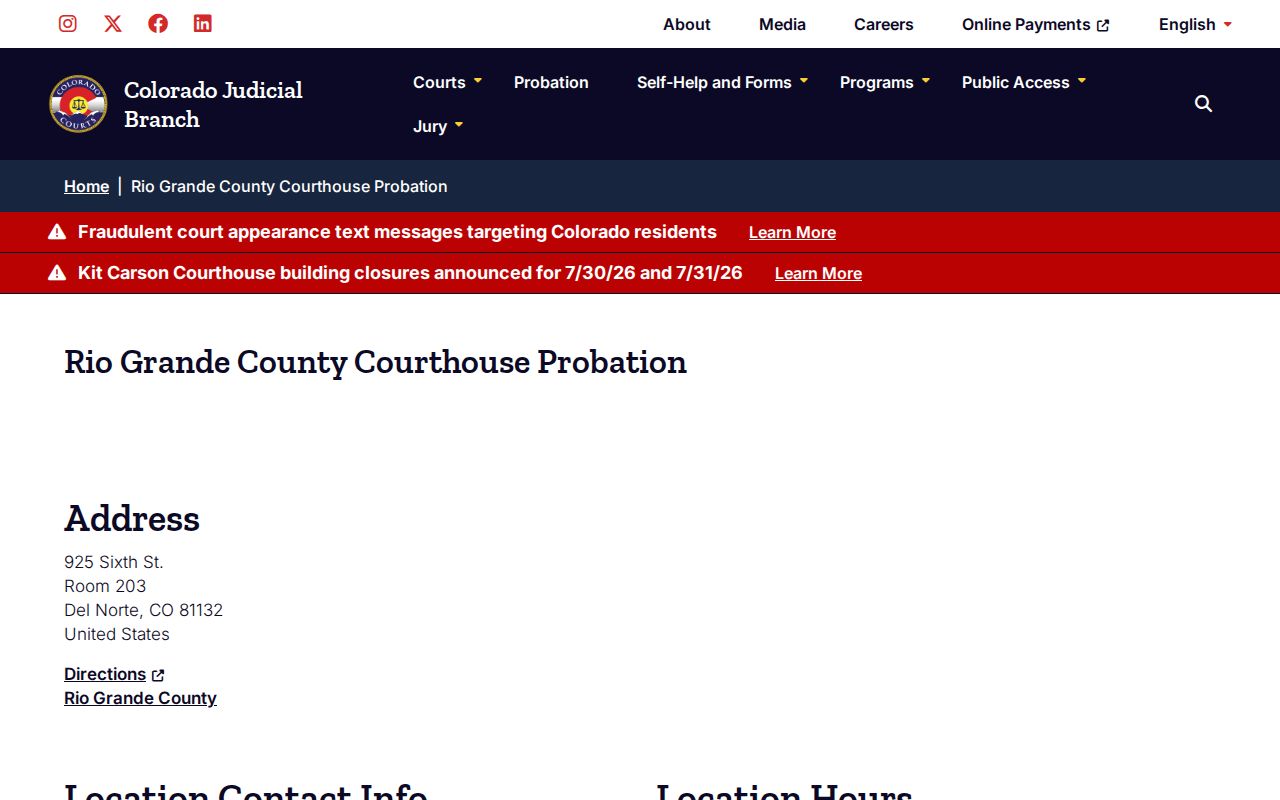
Rio Grande County has a concrete local probation office, and that makes probation easier to route than parole. Rio Grande County Courthouse Probation is listed by the Colorado Judicial Branch at 925 Sixth St. Room 203 in Del Norte, phone 719-657-2202, email 12Probation@judicial.state.co.us, with hours Monday through Friday, 8:00 a.m. to 5:00 p.m. This is the right local office for court-ordered probation questions and reporting-location information. It is not the parole board and should not be used as the first stop for a state-prison parole case.
| Probation office | Rio Grande County Courthouse Probation |
|---|---|
| Address | 925 Sixth St. Room 203, Del Norte, CO 81132 |
| Phone | 719-657-2202 |
| 12Probation@judicial.state.co.us | |
| Hours | Monday-Friday, 8:00 a.m. to 5:00 p.m. |
| Official page | Colorado Judicial Branch probation location |
Colorado Parole Hearing Records
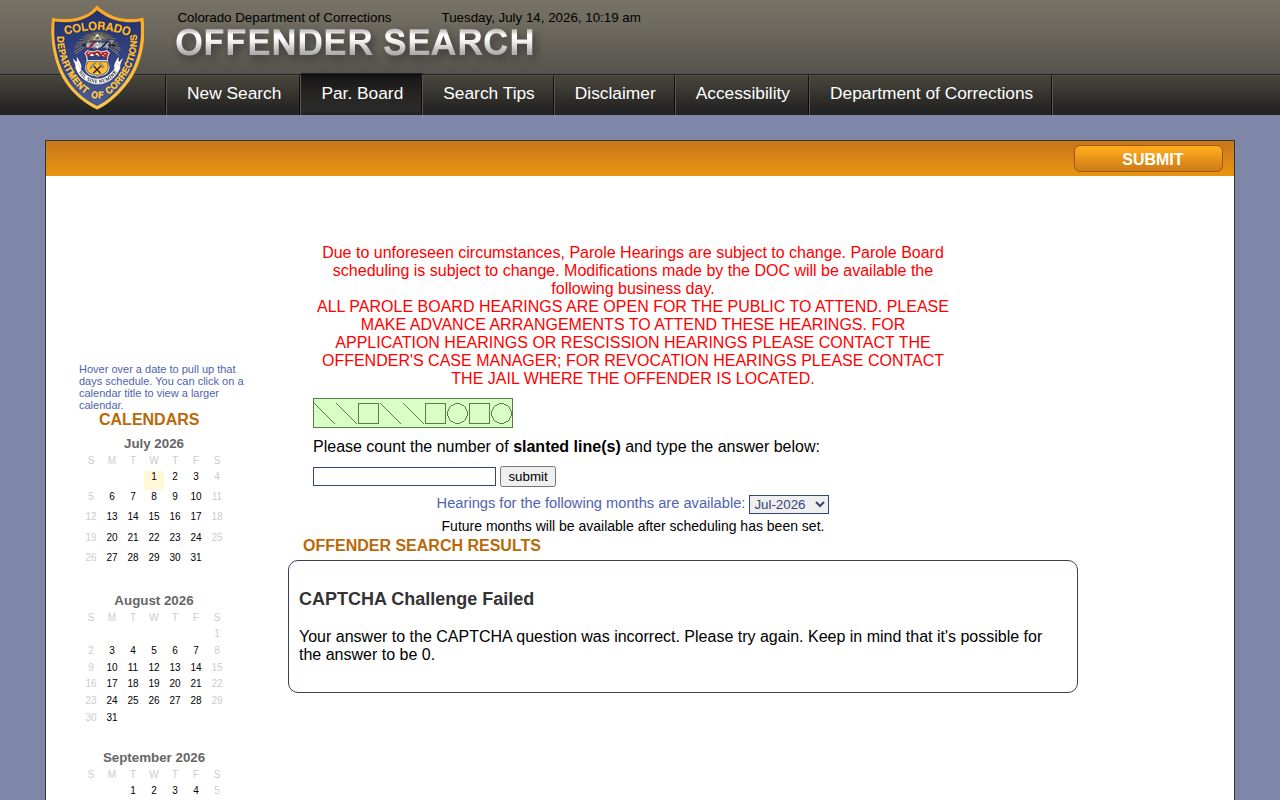
The Colorado State Board of Parole hearing calendar is available inside the CDOC offender-search system. During research, the calendar showed monthly schedules, stated that future months become available after scheduling is set, and warned that parole hearings are subject to change. It also said scheduling modifications made by DOC will be available the following business day and that public attendance requires advance arrangements. Application and rescission hearing attendance questions are directed to the offender's case manager, while revocation hearing questions are directed to the jail where the offender is located.
A hearing entry is not the same as release proof. A parole application hearing may lead to release, a deferment, a deferment to mandatory release, or another board action. A prior grant can be revisited in a rescission hearing before the effective date. A revocation matter can return a person to custody. Confirm the actual release or return status in CDOC, VINE, the receiving jail, or the supervising parole channel before treating a hearing result as final.
Conditions, Warrants, and Absconders
Post-release supervision can include reporting, treatment, location restrictions, payment requirements, no-contact orders, testing, and other case-specific conditions. The public page should not guess at a person's conditions. Verify conditions through the court order, probation order, CDOC/parole record, or the supervising office when the information is releasable. A person can be released from Rio Grande County Jail and still have court conditions. A person released from prison can still be under Adult Parole Services.
No Rio Grande County-specific public absconder list was found in the official research. If a parole warrant or absconder issue is suspected, use CDOC/parole channels and check the county jail only if the person may be physically lodged there. If VINE shows the person returned to custody, treat that as a custody-status signal and reconcile it with the jail, CDOC, court, or parole officer record. If the person was released to another agency, ask the sheriff which agency accepted custody.
For probation, a warrant or violation question usually points back to the court file and probation office. For parole, the same question belongs with CDOC, the parole board process, and any jail that physically holds the person for a revocation matter.
Official-Action Records for Supervision
Colorado criminal-justice release records are handled under CCJRA rather than ordinary administrative-record rules. The Colorado Attorney General explains that records of official action include arrest, disposition, pretrial or posttrial release from custody, decisions to grant, order, or terminate probation or parole, and participation in correctional or rehabilitative programs. That makes a narrow official-action request useful when the question is whether a Rio Grande County release led to probation, parole, transfer, or discharge.
For a Rio Grande County probation question, the most useful official-action records are usually the sentencing order, probation order, later modification orders, and any termination order. For a parole question, the useful records are the CDOC offender record, parole-board action, release status, revocation record, or discharge confirmation. If the person moved through Rio Grande County Jail before state custody, keep the local release record separate from the later parole record so the timeline does not blur one custodian's release with another custodian's supervision.
San Luis Valley Reentry Context
Research found reentry resources that appear regional rather than county-owned. An Alamosa County grant narrative described a detention center recovery and reentry program serving the San Luis Valley, and the Center for Restorative Programs operates in the San Luis Valley restorative-justice landscape. Those resources may help orient people after release, but they do not verify an individual Rio Grande County release, probation status, parole status, or discharge. Use them only as community-navigation context, then confirm supervision through the official sheriff, court, probation, CDOC, VINE, or parole channels.
ID, property, and source-record correction questions also belong with the agency that created the record. The sheriff is the local contact for a jail release record, the Combined Court is the source for orders and docket events, the probation office handles local supervision logistics, and CDOC controls state-prison parole records. VINE and mirrored search results generally depend on those agency records, so corrections should start at the official source.
How Rio Grande Supervision Ends
Probation ends through a court or probation process, and parole ends through CDOC/parole discharge. A jail release, a VINE status change, or a court hearing does not automatically mean supervision is finished. For probation, look for a court order, case event, or probation termination information. For parole, look for CDOC status, parole discharge, or official parole-board/CDOC confirmation. For the broader custody trail, pair this page with the release-record workflow on Rio Grande County released inmates, where county jail release records, court records, CDOC records, and VINE are separated by custodian.
Use the word discharge only when the source shows that the sentence or supervision duty ended.