
Projected vs Actual Release Date
A projected release date is a planning date produced by a sentence, custody system, and earned-time calculation. It is not the same thing as the actual release event. The actual release is the moment the jail, prison, or agency records the person leaving that custody status. For Rio Grande County users, this distinction matters because a person may have a court-related bond release, a local sentence completion, a transfer to CDOC, a release to parole, a detainer pickup, or a federal or immigration transfer.
Pretrial detainees are different from sentenced inmates. A person held before trial at Rio Grande County Jail usually does not have a sentence-based release date. Release may occur when bond is posted, the court orders release on recognizance, charges are dismissed, another agency clears a hold, or a judge changes conditions. The sheriff release record can show the operational date and time, while Rio Grande Combined Court explains the legal authority behind the release.
Find a Rio Grande Release Date
Start by identifying the last known custody type. The county jail, state prison, federal prison, ICE detention, and court probation systems do not share one public release-date screen. A released county-jail detainee may never appear in CDOC. A person sentenced from Rio Grande County to prison may leave the jail but later appear in CDOC. A federal or immigration transfer may look like a county release even though the person went to another agency.
- For a local jail booking, call the Rio Grande County Sheriff's Office at 719-657-4000 and ask for release date/time, release type, and whether the release was to the community or another agency.
- Check Rio Grande Combined Court when release followed bond, sentencing, dismissal, probation, warrant return, or another court event.
- For a state-prison sentence, search the CDOC offender search by DOC number first if known.
- Use the CDOC record to distinguish custody, parole, release, and discharge; confirm important dates directly with CDOC because CDOC warns that database information may sometimes be inaccurate.
- Use VINELink Release Check before release when an alert is needed, then reconcile the alert with the sheriff, court, or CDOC.
- If the record says transfer, hold, or release to another agency, follow the receiving agency: BOP for federal prison, ICE ODLS for immigration custody, USMS/federal court for federal pretrial custody, or another county if named.
CDOC Prison Release Dates
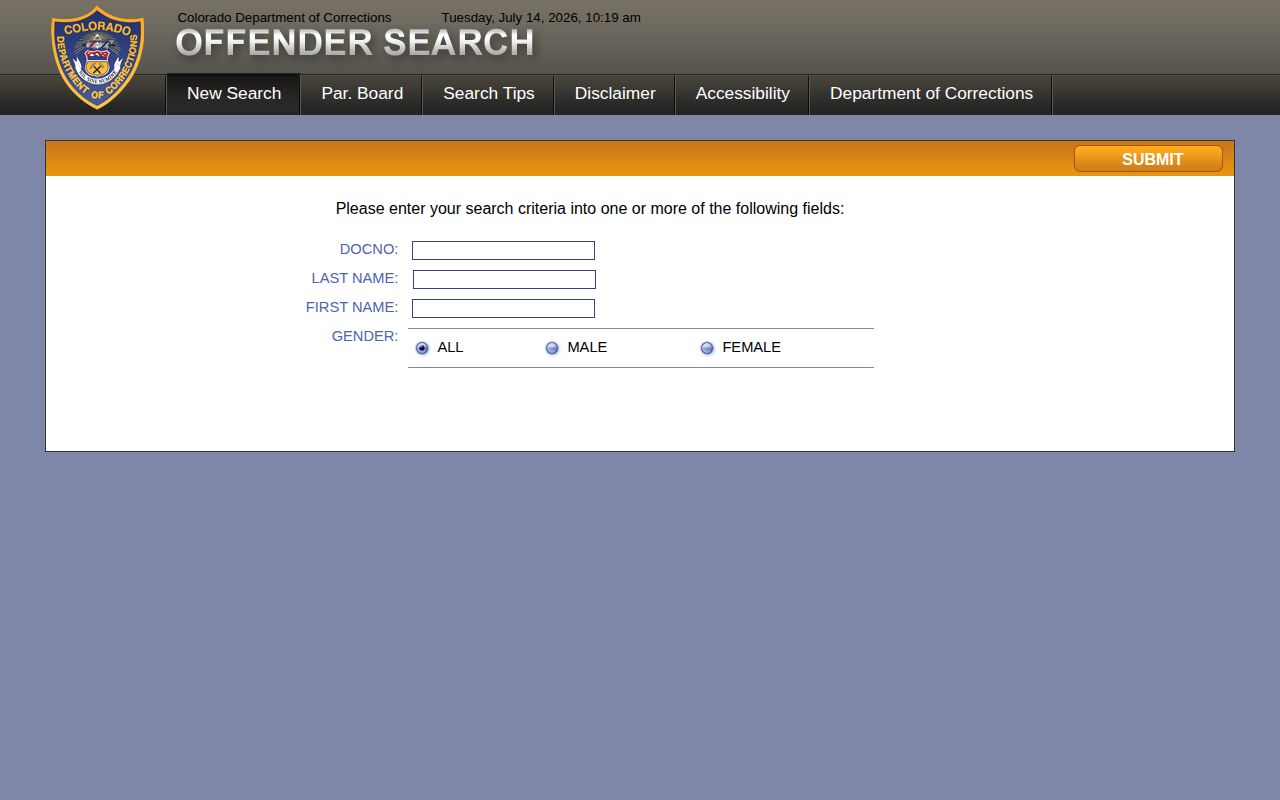
The Colorado Department of Corrections offender search is the statewide source for people who entered Colorado state-prison custody. It is not a Rio Grande County jail roster. The visible CDOC form includes DOC number, last name, first name, and gender, and the search tips discuss date-of-birth searching. CDOC says the DOC number is assigned by the department, can be up to six numeric characters, and is the primary way it identifies offenders. If the DOC number is available from court papers, mittimus, old prison mail, or a prior CDOC result, use it before a name search.
Name searches need flexibility. CDOC search tips say first and last name fields return matches whose names begin with the typed letters, which can help when spelling is uncertain but can also produce false matches. CDOC also says not to hyphenate between two last names and notes that the offender name on record may be the arresting or prosecuted name rather than a later legal name. If a Rio Grande County case led to prison, the court case can supply the DOC transfer context while CDOC supplies prison status and date information.
Colorado Earned-Time Rules
Colorado state-prison earned time is governed by C.R.S. 17-22.5-405. The statute authorizes earned time generally not exceeding ten days per month based on progress categories and certification by case managers or community parole officers. It also authorizes up to twelve days per month for certain qualifying class 4, class 5, class 6 felony and level 3 or level 4 drug felony inmates who meet statutory conditions. CDOC reviews performance and can grant, withhold, withdraw, or restore earned time under the statute.
Parole eligibility is governed separately by C.R.S. 17-22.5-403. Eligibility is not guaranteed release. A person may be eligible to see the parole board, but the board can release, defer, defer to mandatory release, rescind a prior grant, or take another official action. The 2024 Colorado Blue Book summary for Proposition 128 states that certain crimes of violence committed on or after January 1, 2025 require service of at least 85 percent of the sentence before discretionary parole eligibility or earned-time reduction can reduce the sentence. Older offense dates and different offense categories may follow different rules.
| Colorado date concept | How to read it |
|---|---|
| Parole eligibility | The first point the person may be considered for parole under the controlling statute; it is not a release promise. |
| Mandatory release | A statutory release framework that may still depend on earned-time allowances, holds, parole issues, and sentence details. |
| Sentence discharge | The end of the sentence or supervision obligation when the source records discharge rather than only release. |
| Earned time | Time allowances that may reduce a date if granted and retained under C.R.S. 17-22.5-405. |
Rio Grande Jail Good Time
County-jail sentence deductions are not calculated under CDOC parole rules. Colorado's county-jail statute, C.R.S. 17-26-109, provides a seven-day deduction for each thirty days on the sentence calculated pro rata, subject to forfeiture for rule violations or failure to accept or complete duties. It also contains additional earned/trusty-time provisions. Rio Grande County did not publish a local jail good-time schedule in the official sources found during research, so a county-jail projected release date should be confirmed directly with the jail or sentencing court.
This two-track explanation is essential for Rio Grande County. A local misdemeanor or county-jail sentence should not be calculated from CDOC earned-time rules. A state-prison parole eligibility date should not be treated as a guaranteed release date. If the person was sentenced locally but transferred to CDOC, use the court record to confirm the sentence and CDOC to confirm the prison status and date calculations.
Why a Release Date Changes
Future release dates can change for legal and operational reasons. Bond can be posted while staff still clears warrants or holds. A court can amend a sentence or correct jail-time calculations. CDOC can update earned time. A parole board can defer release, and a parole grant can be rescinded before the effective date. A detainer can route the person to another agency even though the county or prison release occurs on paper.
| Factor | Effect on the date |
|---|---|
| Good-time or earned-time change | Earned-time allowances can be granted, withheld, withdrawn, restored, or recalculated, moving a projected date. |
| Court order or sentence correction | A bond order, amended mittimus, jail-time correction, dismissal, or sentencing order can change release authority. |
| Parole decision | A hearing may lead to release, deferment, mandatory-release timing, rescission, revocation, or continued custody. |
| Detainer or hold | Another county, CDOC, USMS, BOP, ICE, or another agency may accept custody after the local release. |
| Processing and transport | The legal release authorization and the actual time the person leaves a facility may differ. |
Parole Calendar Is Not Release Proof
The Colorado State Board of Parole calendar is available at the CDOC parole calendar page. Research found that the page shows monthly calendars, says future months become available after scheduling is set, and warns that parole hearings are subject to change. Scheduling modifications made by DOC are available the following business day. Public attendance requires advance arrangements, and questions are routed differently for application, rescission, and revocation hearings.
Use the calendar to understand where a parole decision may enter the timeline, not to prove that a release occurred. A hearing can be scheduled, continued, deferred, or followed by a board action that still needs release-plan work, detainer review, or CDOC processing. Confirm the final status in CDOC, VINE, parole records, or the receiving custody agency.
No County Release-Date Feed Found
No official Rio Grande County public 24-hour release feed, 72-hour release feed, current roster, or booking-photo roster was found on the official sheriff page during research. That means the county pages should not claim a public refresh interval or a visible release-window retention period. For a recent local release, call the sheriff, ask for the record of official action showing release from custody, and check Rio Grande Combined Court if the release came from bond, sentencing, dismissal, or another court event.
If the person was still in custody before release, use Colorado VINE registration for a release or transfer alert. If the person was already released and no VINE registration existed, the better historical sources are sheriff records, court records, and CDOC/BOP/ICE records when the custody trail moved outside the county jail.
Confirming the Actual Date
When the date matters, confirm it with the custodian that owns the record. For Rio Grande County Jail, ask the sheriff for booking number, booking date/time, release date/time, release type, case number, bond status if applicable, and any receiving agency if the release was a transfer. For Rio Grande Combined Court, request the bond order, sentencing order, mittimus, probation order, dismissal, warrant return, or Register of Action entry that explains why release occurred.
For CDOC, start with the public offender search and then contact CDOC or the supervising office if the public result is not enough. CDOC's own disclaimer says users should contact CDOC to confirm information because database information may sometimes be inaccurate. For BOP, a past release date with no facility means the person is no longer in BOP custody, but BOP also notes the person may still be in another correctional or criminal-justice system. For ICE, ODLS is for people currently in ICE custody or in CBP custody more than 48 hours.